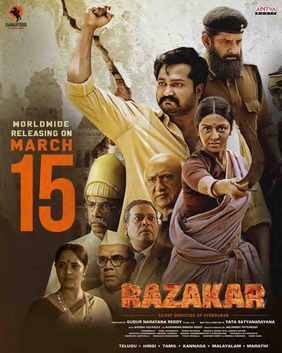
Yata Satyanarayana, dir. Razakar: The Silent Genocide of Hyderabad
Hyderabad: Samarveer Creations LLP, 2024, 166 min.
Keywords:
Razakars, Hyderabad, Nizam Shahi, Integration of States, Communal violenceAbstract
This film review attempts to analyse the 2024 Telugu film Razakar: The Silent Genocide of Hyderabad. A “historical” action-drama, directed by Yata Satyanarayana, it becomes an important piece of media for critical examination, especially in light of the fact that it is an almost perfect case study to illustrate how movies become a popular and powerful visual medium of collective memory and collective amnesia simultaneously. Set against the backdrop of the integration of the princely state of Hyderabad into the Indian Union, the movie woefully utilises a religious prism to memorialise a series of politically motivated events.
References
Ejaz, Umair and Sheed Isheal. Cinema as Historical Archive, ResearchGate, June 2025, https://www.researchgate.net/publication/392554005_Cinema _as_Historical_Archive. (accessed September 20, 2025).
Fossati, Giovanna, and Annie van den Oever. “Introduction: Exposing the Film Apparatus” in Exposing the Film Apparatus: The Film Archive as a Research Laboratory, edited by Giovanna Fossati and Annie van den Oever, 13-42. Amsterdam: Amsterdam University Press, 2016.
Hyder, Mohammed. October Coup: A Memoir of the Struggle for Hyderabad. New Delhi: Lotus Collection, 2012.
Karmakar, Goutam, and Pippa Catteral. “Nation, Nationalism and Indian Hindi cinema.” National Identities 27, no. 1-2 (2025): 1-11.
Nanisetti, Serish. “Using cinema to stoke communal tensions.” The Hindu, September 15, 2023. https://www.thehindu.com/opinion/op-ed/using-cinema-to-stoke-communal-tensions/article67307190.ec. (accessed September 17, 2025).
Pecheti, Prakash. “Razakar: Silent Genocide of Hyderabad review: This right-wing Hindutva narrative falls into the ‘commercial cinema’ trap.” South First, March 15, 2024. https://thesouthfirst.com/entertainment/razakar-telugu-movie-review/. (accessed September 10, 2025).
Paradakshina. “Razakar: The Silent Genocide of Hyderabad- The definitive untold true story of Hyderabad on the screen.” PGURUS, March 28, 2024. https://www.pgurus.com/razakar-the-silent-genocide-of-hyderabad-the-definitive-untold-true-story-of-hyderabad-on-the-screen/. (accessed August 23, 2025).
Purushottam, Sunil. “Federating the Raj: Hyderabad, Sovereign Kingship, And Partition.” Modern Asian Studies 54, no. 1 (2020): 157-198.
Purushottam, Sunil. “Internal Violence: The “Police Action” in Hyderabad.” Comparative Studies in Society and History 57, no, 2 (2015): 435-466.
Rajendran, Sowmya. “Razakar is a rabid Hindutva project that uses horrifying violence to peddle hate.” The News Minute, April 26, 2024. https://www.thenewsminute.com/flix/razakar-is-a-rabid-hindutva-project-that-uses-horrifying-violence-to-peddle-hate. (accessed August 28, 2025).
Ravibabu, M. “How the Movie ‘Razakar- Silent Genocide of Hyderabad’ Sets Out to Distort History.” The Wire, October 17, 2023. https://thewire.in/film/how-the-movie-razakar-silent-genocide-of-hyderabad-sets-out-to-distort-history. (accessed September 7, 2025).
Reddy, Capt Lingala Pandu Ranga. “Of Bonds, Broken Promises and Betrayals.” Deccan Chronicle, September 17, 2019. https://www.deccanchronicle.com/opinion/op-ed/170919/of-bonds-broken-promises-and-betrayals.html. (accessed August 27, 2025).
Sherman, Taylor C. Muslim Belonging in Secular India: Negotiating Citizenship in Postcolonial Hyderabad. Cambridge: Cambridge University Press, 2015.
Sherman, Taylor C. “The Integration of the Princely State of Hyderabad and the Making of the Postcolonial State in India, 1948-56.” Indian Economic and Social History Review 44, no. 4 (2007): 489-516.
Downloads
Published
How to Cite
Issue
Section
Categories
License
Copyright (c) 2025 Stuti Suhani

This work is licensed under a Creative Commons Attribution-NonCommercial-ShareAlike 4.0 International License.


